


 Written by Yanis Kharchafi
Fiduciary Expert in Training
HEC/AFA/IAF Graduate
Communal income taxes in Valais
Introduction :
When talking about the canton of Valais, the first things that might pop into one’ s mind are the 4,000-meter-high peaks, the breathtaking (and ligament-cutting) ski slopes or the small villages full of genuine raclette cheese. But many others also think of its supposedly rather generous tax system.
Who hasn’t heard someone say: “Ah, that one didn’t choose Valais by accident… if you know what I mean!”?
Do you live in Valais? Or would you like to follow the path of all those who enjoy its high-peaks and low-tax landscapes?
Let’s navigate together the Valaisan tax burden waters. Remember, there are 3 taxation layers. This paper will only address one aspect of the taxes in Valais, namely the communal taxes. If interested in the cantonal, federal or wealth taxes, please refer to our dedicated articles. If you would like us to prepare your tax return for the Valais, don’t hesitate to contact us.
The line-up:
Step 1: Find out your taxable income in Valais
Of course, each canton has its own specificities, but essentially the flow is comparable to all others. I therefore invite you to read our article on taxable income or alternatively, below is a pictorial summary:
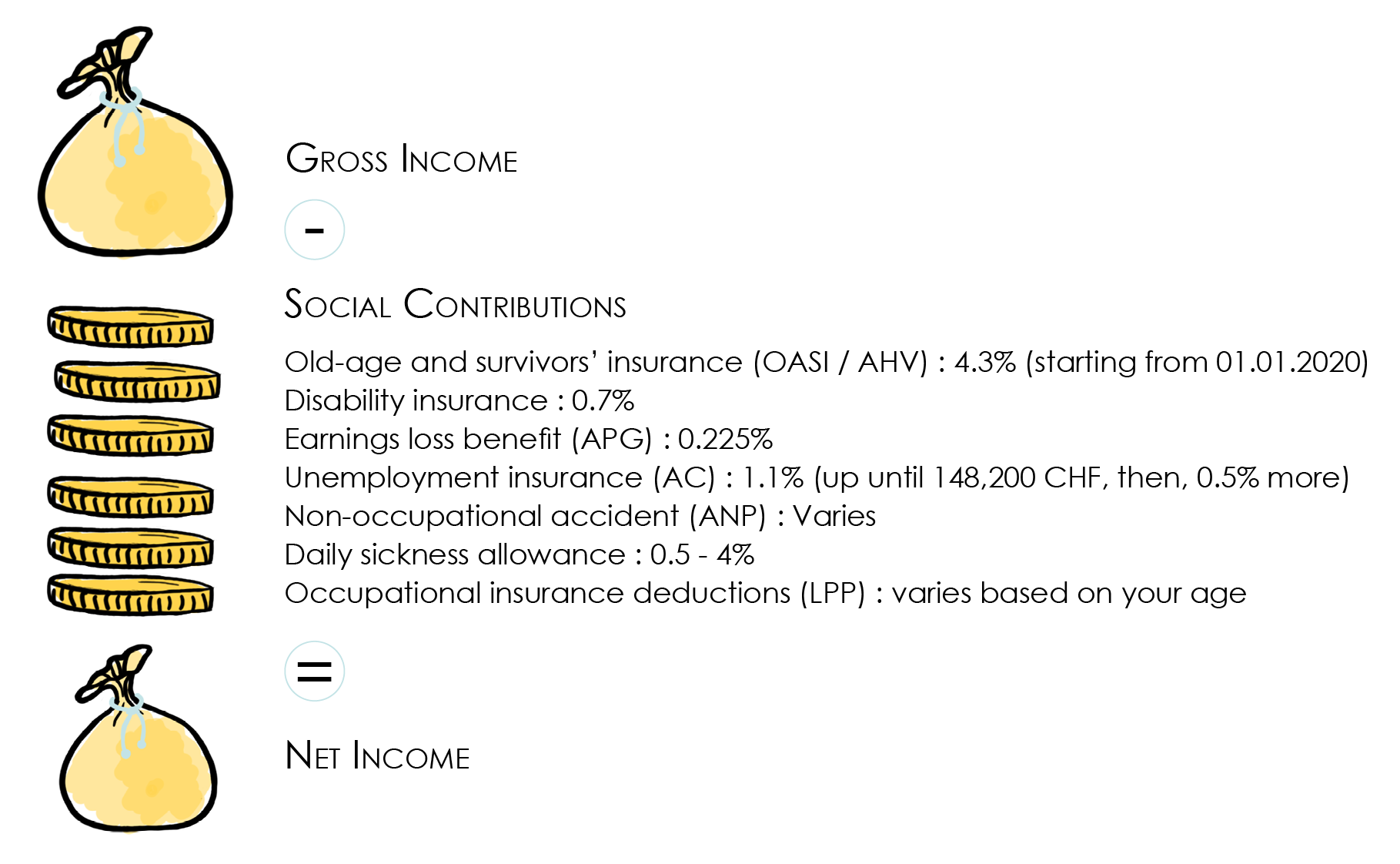
In Switzerland, you will generally sign an employment contract based on a gross salary, and that salary will then be reduced by social insurance contributions.
- AVS (1st pillar)
- Unemployment insurance (AC)
- Family insurance
- Basic and supplementary accident insurance (LAA – LAAC)
- 2nd pillar (Occupational pension – LPP)
- Etc.
Once your net salary is calculated, it will be transferred to your account. Over the months, these amounts will accumulate, and at the end of the year (or rather at the beginning of the following year), you will receive a salary certificate summarizing these amounts, including your annual net salary. This document serves as the starting point for determining your taxable income, as all social contributions are deductible.
After calculating your salary, Swiss tax laws allow for certain deductions (standard or actual) that can further reduce your net income to determine the taxable income. A small clarification: although Swiss tax laws are generally applied across all cantons, each canton has the flexibility to interpret and adapt these laws to their specific guidelines. As a result, taxable income at the cantonal level often differs from the taxable income at the federal level.
Do you pay a lot of taxes in the canton of Valais?
This is the most frequently asked question from our clients: Should I move to Valais to lower my tax burden? Rather than answering this question outright, I invite you to explore the facts and decide for yourself.

The easy conclusion would be to say that Valais is never listed among the “worst cantons”, but it is not consistently voted the “best canton” either. Let’s admit it, though, that is still true for two out of our three examples. Moreover, as you will see further down in this article, Verbier stands out as one of the least expensive municipalities in Valais. In other words, had we chosen different municipalities, the result could have looked very different.
The most honest conclusion, therefore, would be: it depends…
Now that we’ve laid the groundwork, let’s dive into the details of calculating municipal taxes.
Step 2: Municipal Indexation
The inde-what? Yes, for those who have already read our article on Valais cantonal income tax… here we are again! Luckily, the same system applies at the municipal level, so the mechanism of deindexation—let’s not shy away from the term—will be similar. However, unlike the cantonal scale, which is uniform across Valais, each of the 122 municipalities has its own index, ranging from 110% to 176% in 2025. This means more or fewer iterations.
For the newcomers, let’s start with the basics. Why has the Valais tax authority decided to use this system and call it such? And why did they opt for such a system in the first place? Even the most curious and determined researchers won’t find a straightforward explanation on Google. To solve this mystery, you’ll need to become acquainted with… DESINDEXATION.
Let’s break it down step by step:
- The concept: Each municipality in Valais assigns itself an “indexation percentage”, or simply an “index”. This index determines the income that will be taken into account to calculate your tax rate.
- The Range of Indexes: In 2025, municipal indexes range from 110% to 176%. Spoiler alert: for the same income, the higher the index, the lower the tax rate… but the more iterations needed to find this so-called rate-determining income. That’s how the game is played.
To help you, here’s a table showing the different indexations based on your municipality:
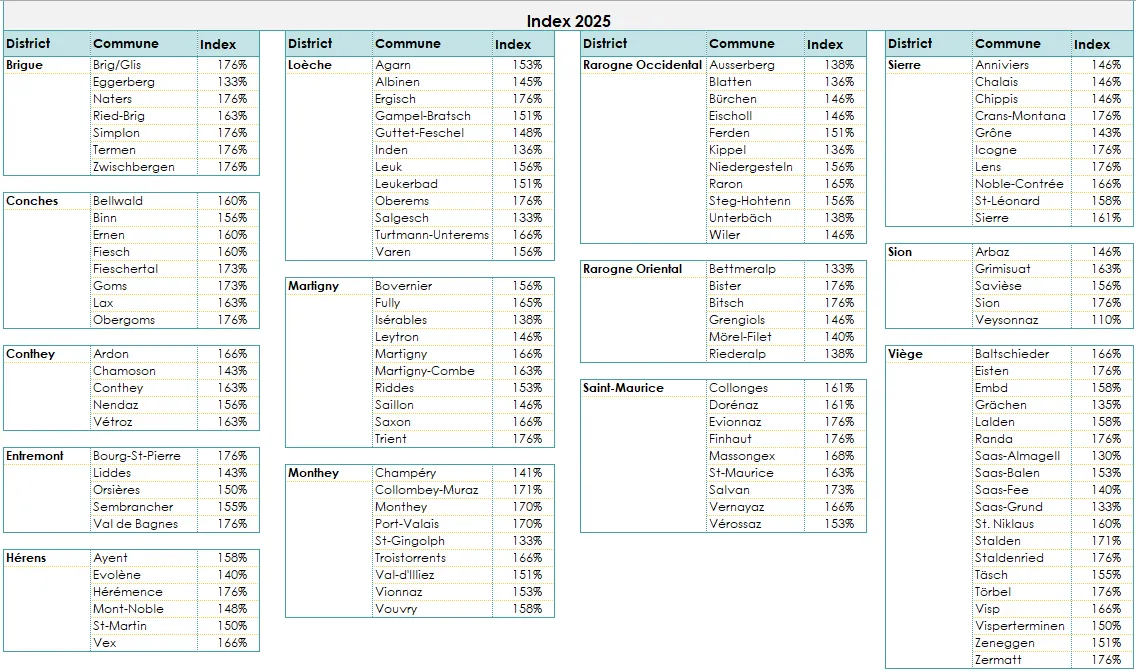
Yes, I know, it still sounds a bit vague, but don’t worry, once we go through the example, everything will become clear.
PS: Here is the link that will take you to the official index table.
Let’s get back to our Nez Noirs (only Valaisans will get the reference) and to our CHF 70,000 of taxable ICC income.
If I had decided to hone my skiing skills in the renowned Verbier resort, located in the Val de Bagnes, I would be dealing with an index of 176%. Here’s how the process would look :
- 1. Key Tip: To deindex, divide by 1.1 as many times as there are tens in the index. For Verbier, the index is 176%, so you divide 7 times by 1.1. Don’t forget to truncate the decimals after each iteration (no rounding). Finally, perform one additional division by 1.0X, where X is the number of units in the index (e.g., for 176%, the last division will be by 1.06). Still unclear? We get it, it’s a complex system. Below, we’ll illustrate the process with detailed calculations.
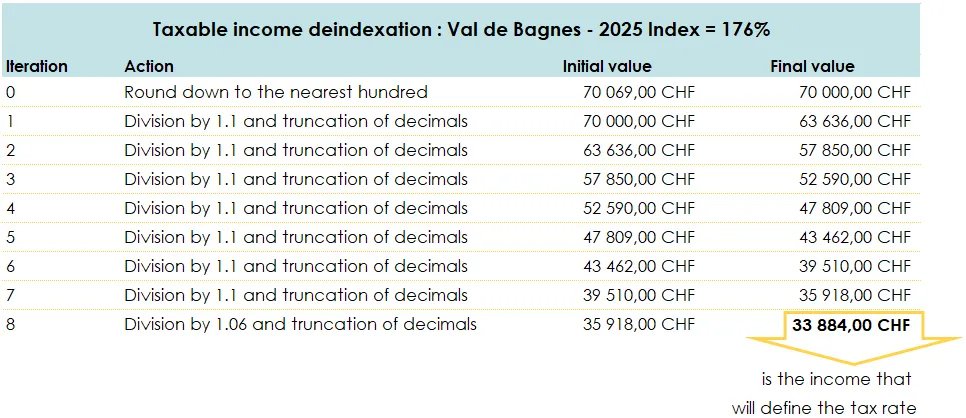
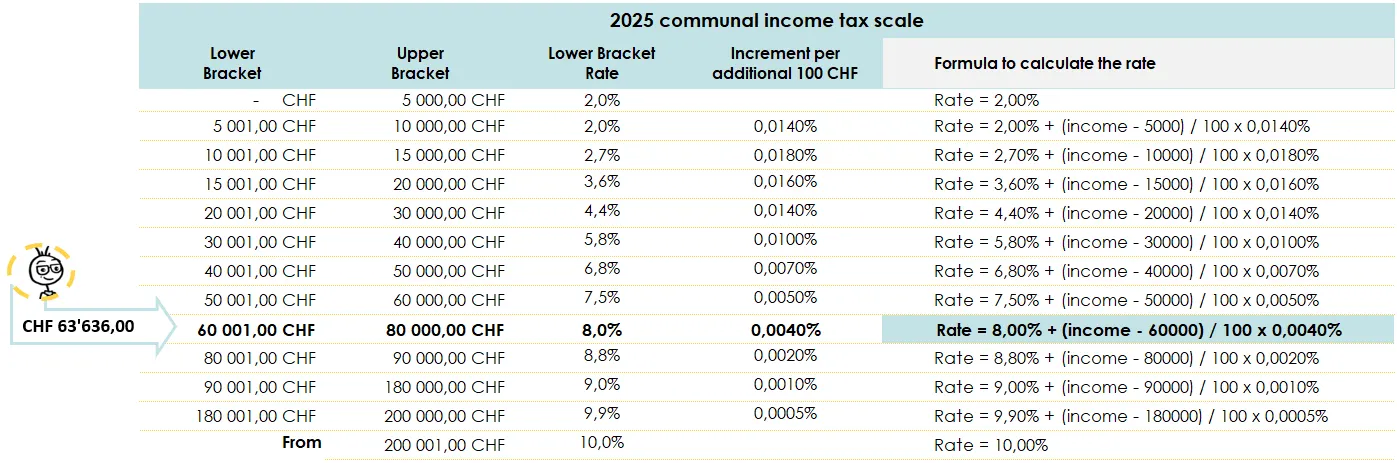
- 2. Finding the Rate: The second step is to find the tax rate corresponding to the de-indexed income in the municipal tax schedule. With a de-indexed income of CHF 33,884, I will apply the following formula to determine my municipal tax rate:
5.80% + (33,884 – 30,000) / 100 * 0.010% = 0.061884, or 6.1884%.
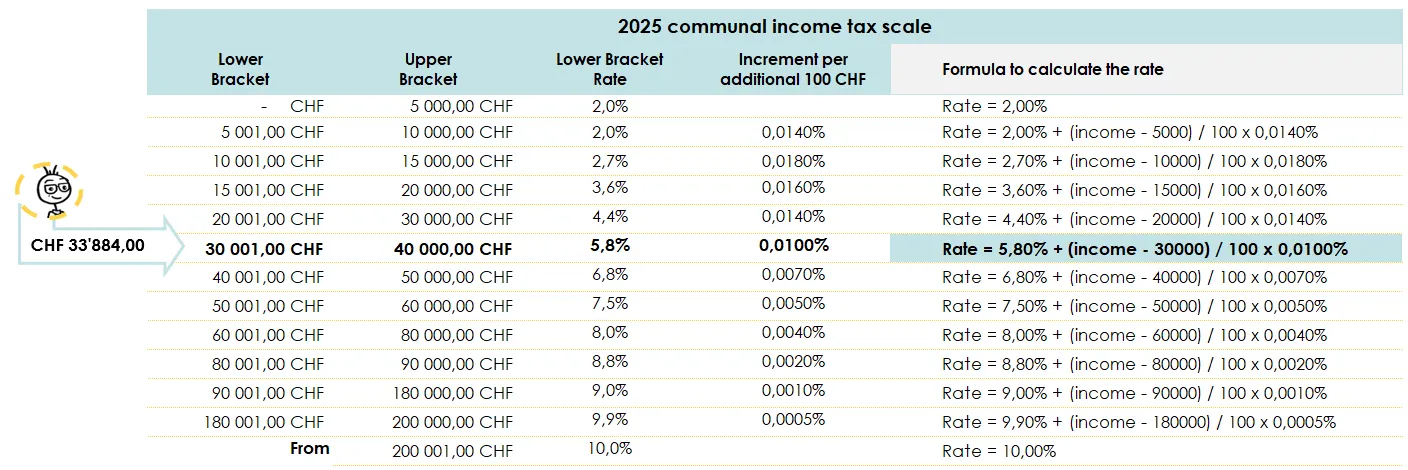
- 3. Calculation of the base tax: My base municipal tax in Val de Bagnes amounts to CHF 4,331.88 (= CHF 70,000 taxable * 6.1884%).
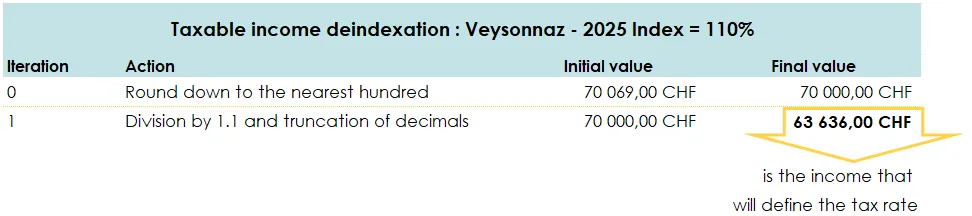
Whereas if I had chosen the view of the Rhône and the Bernese Alps by settling in the municipality of Veysonnaz (Index 110 percent), the de-indexation would have been much faster, sure, but at what cost? Let’s take a look. The answer: a higher base tax rate.
8.0 percent + (63,636 – 60,000) × 0.04 percent = 8.1454 percent, for a cantonal base tax of CHF 5,701.80. That’s still CHF 1,300 more than in Val de Bagnes… Makes you think.
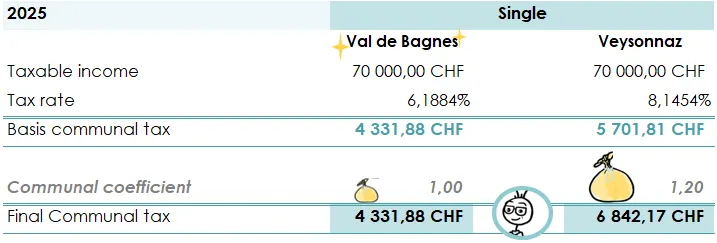
That’s it for this first part, which I summarise for you in the image below.

You now know how the communal indexing works in the canton of Valais.
WARNING: Your base tax is not your final municipal tax! Just a few more lines and you’ll have the full picture.
Step 3: The Municipal Coefficient
Here we go again! After the indexing, it’s time for the coefficient…
To be honest, this coefficient doesn’t do much other than adding a bit of extra confusion. But it’s here to multiply the tax calculated through indexing to determine your final municipal tax amount.
So far, we had a simple rule: the higher the indexing, the more iterations there are, and the lower the tax rate. With the coefficient, it’s the opposite: the higher the coefficient, the higher your tax burden will be.
Each municipality has its own coefficient:
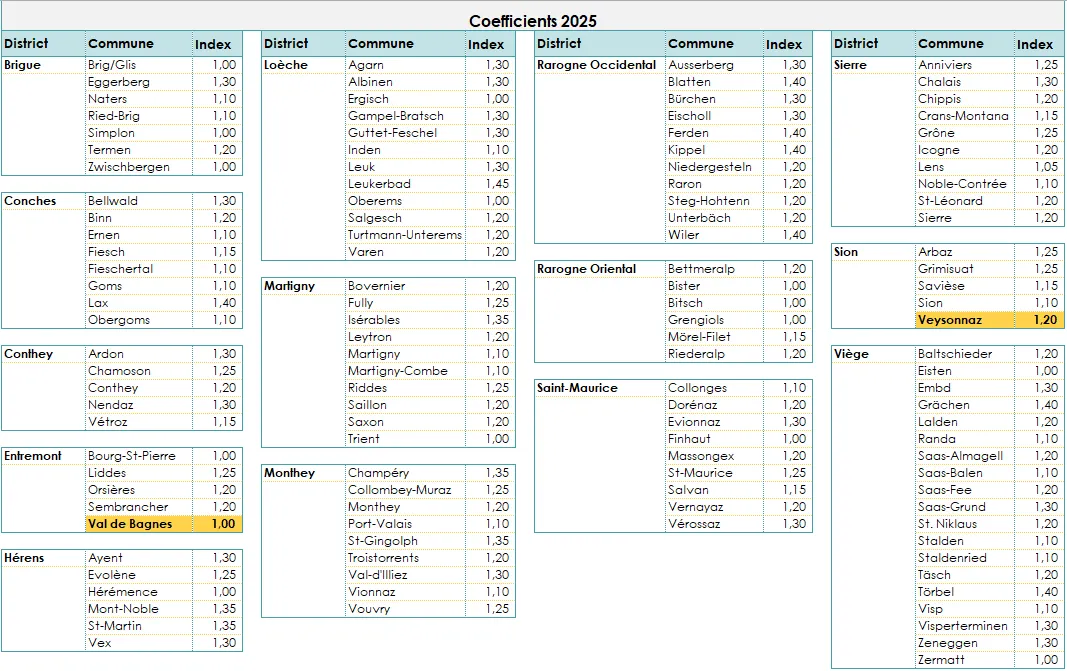
Let’s take the same example again, in other words, me deciding between riding in Verbier in the Val de Bagnes (Coefficient 1) or having my coffee with the best view in Switzerland in Veysonnaz (coefficient 1.20).
In the first case (Verbier), I had a base tax of 4,331.88 CHF, so I simply need to multiply this figure by 1, which gives us: 4,331.88 CHF.
On the other hand, with a coefficient of 1.20, the tax becomes 5,701.81 CHF × 1.20 = 6,842.17 CHF.
And there you go, friends, the Valaisan municipal tax has no more secrets for you!
Finally, not quite… you’ve probably thought the same thing I did. Is it better to look at the coefficient to make my choice? Or the indexation?
Coefficient or indexation, what should you look at to optimize your income tax?
It’s always interesting to know whether the commune where we want to live offers competitive tax advantages.
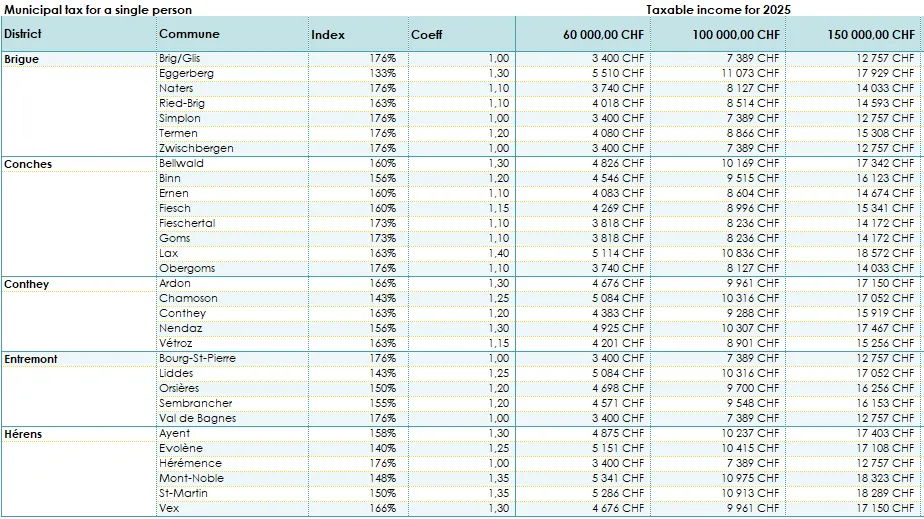
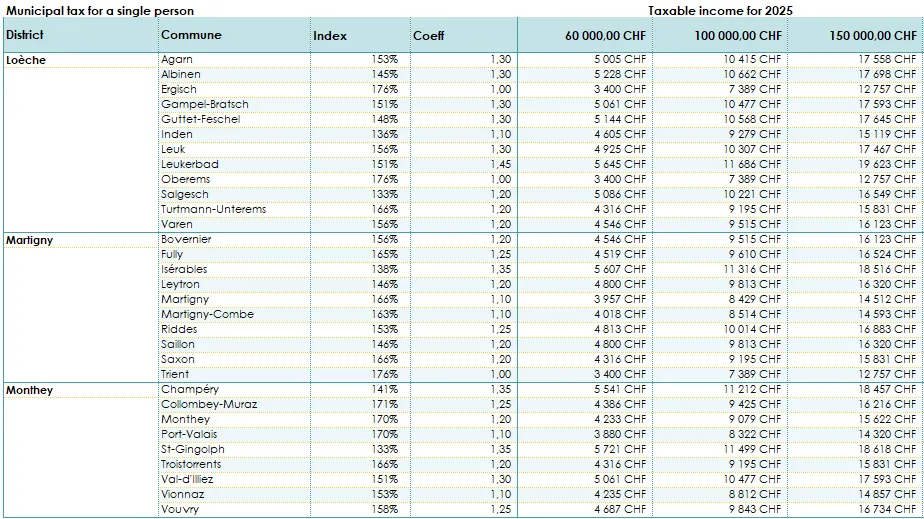
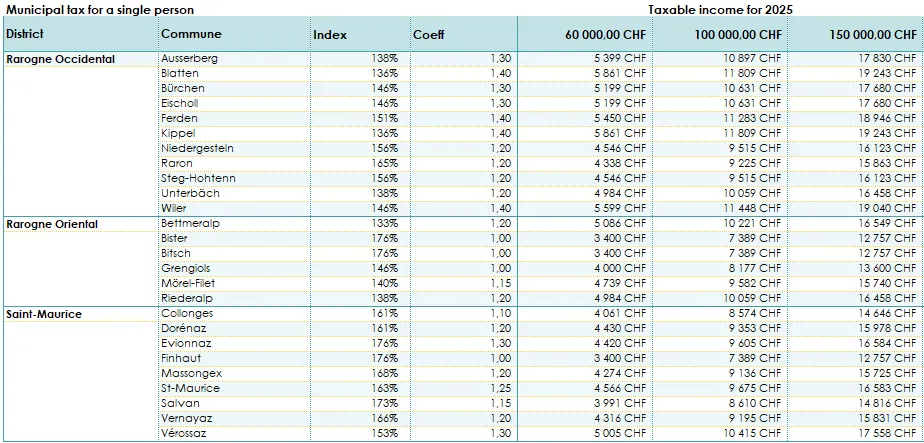
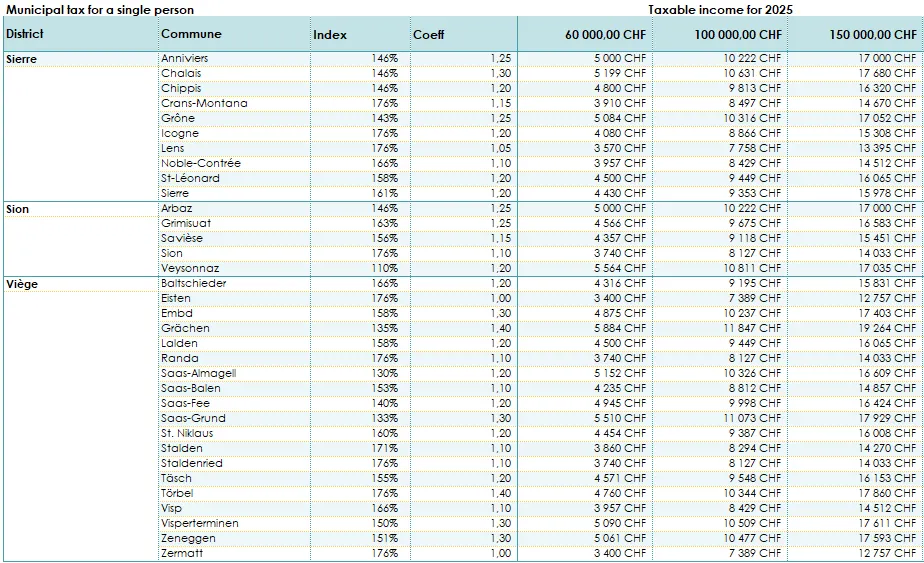
To do this, it’s necessary to take each index and each coefficient and apply them to a taxable income.
After a loooong hesitation (after going through the same steps as I did, you probably know why), we did it. Below, you’ll find four photos with the tax rate and the tax amount for taxable incomes of 60,000 CHF – 100,000 CHF, and 150,000 CHF for all Valaisan communes.
You can then look up your commune and see the potential tax burden you carry compared to your neighbors.
Conclusion?
The most important conclusion is that the commune you choose can have a significant impact on your savings.
For taxable incomes of 60,000 CHF, the difference in tax amounts to 2,484 CHF per year.
This difference is even greater when taxable incomes reach 150,000 CHF. The commune with the highest tax rate will require an additional 6,868 CHF.

From a tax perspective, choosing the right municipality can save you an additional 4 to 5 percent of income. And of course, the higher your taxable income is, the larger these differences become, both in proportion and in absolute value.
How Does Marriage Affect Municipal Income Taxes?
Have you read our article on cantonal taxes in Valais? If so, I suggest you move on to Valais’ wealth tax because the impact of marriage at the cantonal and municipal level is the same.
However, if you haven’t, here’s a quick recap:
The tax benefit related to marriage is calculated based on the tax you would have paid as a single person. Once this amount is known, the communes agree to disregard 35% of this amount.
However, there are two rules:
- Rule 1: The deduction cannot be lower than CHF 680. In other words, whatever your taxable income may be, you will benefit from a tax reduction of at least CHF 680.
- Rule 2: The deduction cannot exceed CHF 4,900. This means that in 2025, you cannot claim a reduction greater than CHF 4,900.
Between these two thresholds, you can subtract 35% of your tax liability.
How Do Children Affect Your Municipal Taxes?
It’s simple: children do not affect the calculation of your taxes. Unlike other cantons like Vaud, which allows for a reduction in the tax rate through the family quotient family quotient in Vaud, Valais communes make no distinction whether you have children or not.
However, I didn’t say that children don’t provide any tax benefits! This only concerns the calculation of the tax, which is not directly impacted.
Nevertheless, having children allows you to lower your taxable income through authorized deductions, such as:
- Childcare costs
- Child allowances
- Etc.
Calculating Your Total Taxes in Valais: ICC + IFD
In this chapter, we’ve explained how municipal taxes work. We hope that now you are able to simulate them. However, to know the total tax bill in Valais, you’ll need to add the cantonal taxes and the federal direct tax.
Oh, and I almost forgot… In these articles, we’ve only talked about income tax, but it’s important to always remember that in Switzerland, unlike in most countries, there is also wealth tax (even for Valais residents)!
How FBKConseils can help you?
A Free initial meeting
Whether you’ve read the entire article or simply scrolled to this section, know that we offer a free initial meeting lasting 15 to 30 minutes. This is a great opportunity to get to know each other, understand your situation and needs, and, most importantly, answer any of your initial questions.
Tax simulation
You may have heard that the canton of Valais is some sort of not-so-secret tax haven? Beware of preconceived ideas! A good tax simulation will quickly show you that this reputation doesn’t always reflect reality. With a few exceptions, taxes in Valais are not much different from the rest of French-speaking Switzerland.
FBKConseils is here to help you clarify the situation and avoid any unpleasant surprises.
2025 Tax Return – Full Delegation
Whether you want to learn how to fill out your tax declaration or prefer to delegate it entirely, FBKConseils is by your side to assist you with your 2025 tax declaration.
2025 Tax Return – Learn how to complete your return with us
For those who prefer to prepare their own tax return without going through a firm, FBKConseils can guide you step by step. We complete the return with you, answer all your questions, and provide the explanations you need so that you can become more independent and make the process easier in the following years.